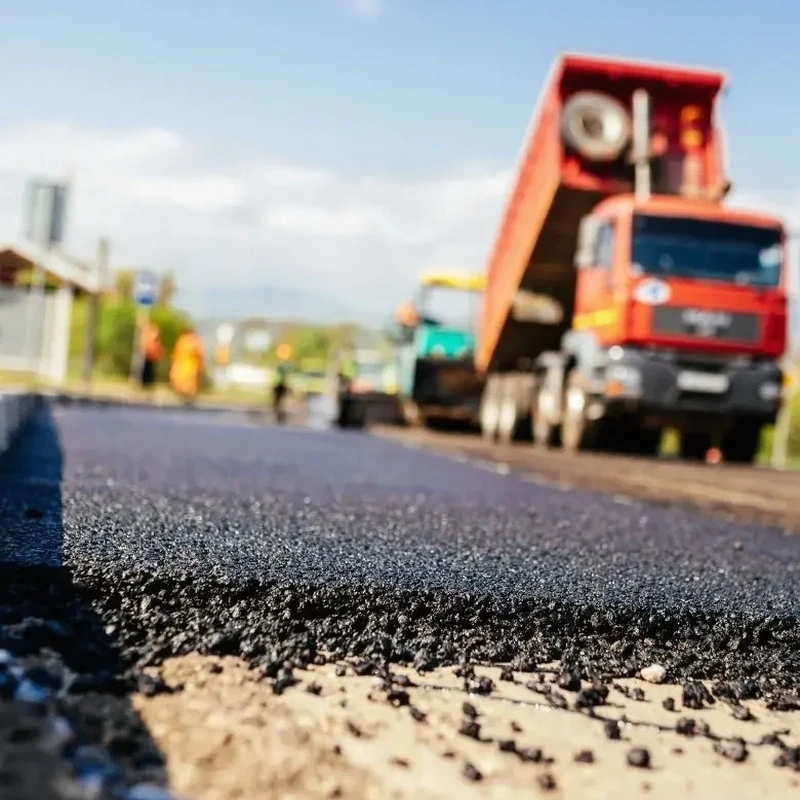
We looked at a failed commercial parking lot off Gordon Drive a few seasons back where the asphalt had alligatored within two years. The owner assumed the mix was bad, but when we cut a test pit, the real story was in the subgrade: saturated lean clay with no drainage path, pumping fines up into the aggregate base with every freeze-thaw cycle. That project reshaped how we approach flexible pavement design in Sioux City—it is never just about layer thicknesses, it is about understanding what the soil beneath will do when the temperature drops to -10°F in January and then swings to 95°F in July. The AASHTO 93 empirical method gives us the structural number, but making a pavement last 20 years here means reading the local geology first. For projects where we suspect highly variable subgrade conditions, we often pair the pavement analysis with a CBR road investigation to calibrate the resilient modulus inputs rather than relying solely on book values that do not capture the Missouri River floodplain variability.
A pavement is only as durable as its weakest subgrade layer—in Sioux City, that weak layer is usually the loess-derived clay that loses stiffness dramatically when moisture content climbs above optimum.
Relevant standards
AASHTO Guide for Design of Pavement Structures (1993, 1998 supplement), ASTM D1883 (CBR test procedure for subgrade and base materials), Iowa DOT Standard Specifications for Highway and Bridge Construction (current series), ASTM D2487 (Unified Soil Classification System for subgrade characterization), ASTM D4694 (Deflection testing with Falling Weight Deflectometer)
Common questions
What is the typical design life for a flexible pavement in Sioux City?
We typically design for a 20-year performance period for arterial and collector streets, and 15 years for residential roads and parking lots, following the Iowa DOT Pavement Design Manual guidance. The actual life depends heavily on construction quality and whether the subgrade was prepared at the correct moisture content—something we verify during construction with nuclear density testing. A well-drained, properly compacted pavement on a stable subgrade can exceed the design life, while one built over wet clay in November may need rehabilitation within eight years.
How much does a flexible pavement design typically cost for a project in Sioux City?
For a complete flexible pavement design package—including subgrade investigation, laboratory CBR testing, traffic analysis, and the final structural section with drainage recommendations—the cost generally ranges from US$1,740 to US$5,690 depending on the size of the paved area and the number of borings or test pits required to characterize the site. A small commercial lot with two borings falls toward the lower end, while a municipal street with variable subgrade conditions requiring five or more test locations will be at the upper end.
Can you design flexible pavements for industrial facilities with heavy forklift traffic?
Yes, and this is one area where standard highway design methods need adjustment. Forklift loads are concentrated on small wheel contact areas and often operate in channelized paths, so we analyze the loading as a point load rather than distributing it over a wide lane. We often specify polymer-modified asphalt binders and reinforced base courses for container yards and distribution centers to handle the turning stresses and static loads from loaded trailers. The subgrade preparation is even more critical here because any settlement under a joint or a heavily trafficked aisle creates a maintenance headache that interrupts operations.
How do you account for frost heave in the pavement design for this region?
Sioux City sits in a region where the frost depth can reach 48 to 54 inches in an open, exposed area, according to the NOAA climate data and Iowa DOT frost depth maps. We classify the subgrade soil using ASTM D2487 and check its frost susceptibility based on the percentage of fines passing the No. 200 sieve. If more than 10% of the material is finer than 0.02 mm, we consider it frost-susceptible and design the pavement structure to either remove and replace that material below the frost line, or to use a capillary break and drainage layer that prevents water from migrating to the freezing front. Without this analysis, ice lenses will form, lift the pavement unevenly, and leave a permanently weakened structure after the spring thaw.