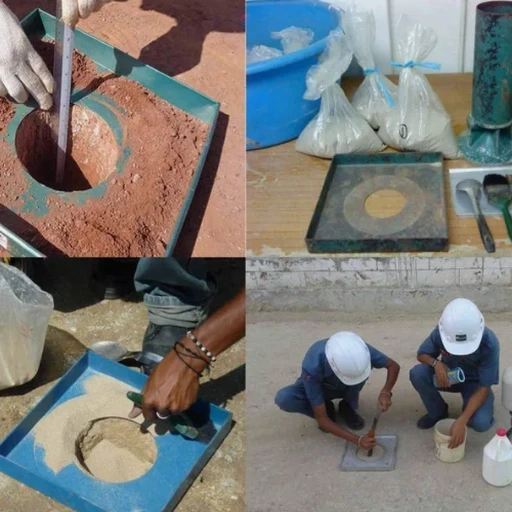
A contractor on Gordon Drive called us out after a rain delay—the fill they had compacted the week before looked fine on the surface, but the proof roller was leaving subtle deflection marks. That is exactly the scenario where a field density test using the sand cone method separates assumption from fact. We pulled seven tests along the building pad that morning, and three came back below 95% of modified Proctor. The crew reworked those zones before the footing inspection, avoiding a stop-work order that would have cost them two dry-weather days. In Sioux City, where glacial till transitions into Missouri River alluvium across less than a mile, density acceptance has to be measured in place—lab curves alone do not capture the variability.
A sand cone test gives you the density of the lift under the plate—not an average over two feet like a nuclear gauge. That matters when compaction is specified per lift.
Local ground factors
The sand cone apparatus itself is simple—a one-gallon plastic jar, a brass cone with a valve, and a base plate with a 6.5-inch diameter hole—but the operator decisions on site make or break the result. In Sioux City, we deal with two recurring problems. First, the loess-derived silts on the bluffs are moisture-sensitive: if the bottom of the test hole is not scraped perfectly clean before pouring sand, loose material collapses into the excavated volume and inflates the density reading. Second, on trench backfill jobs near the river, the sand can absorb moisture from wet granular material and change its bulk calibration density during the test. We re-calibrate the sand cone every 10 tests minimum and whenever the sand changes batch, as required by ASTM D1556 Section 6. The lab also cross-checks sand density weekly against a calibration container of known volume.
Common questions
What does a sand cone field density test cost in Sioux City?
For projects in Sioux City and Woodbury County, a single field density test with the sand cone method typically falls between US$100 and US$140 per point, depending on the number of tests scheduled per mobilization and the travel distance from our lab. Projects with 10 or more tests on the same day are priced at the lower end of that range.
Why choose sand cone over a nuclear density gauge on my Sioux City site?
The sand cone method measures density directly—you excavate a known volume of soil, weigh it, and calculate the in-place density. There is no calibration to a specific soil chemistry, no radiation source to manage, and no moisture interference from the iron-rich glacial till that sometimes throws off nuclear gauge readings in this part of Iowa. It is also the reference method against which nuclear gauges are correlated per ASTM D6938.
How many sand cone tests does the IBC require for a commercial building pad?
IBC Chapter 18 does not prescribe an exact number; it requires that compacted fill be tested at a frequency sufficient to ensure compliance with the approved geotechnical report. In practice, for most commercial pads in Sioux City, that works out to one test per 2,500 square feet of each compacted lift, or a minimum of one test per lift if the pad is small.
How long does it take to get the density test result?
The field procedure takes about 15 to 20 minutes per point. The moisture content sample is sealed on site and oven-dried in our lab; we report the percent compaction the same day if the sample arrives by early afternoon, or first thing the next morning for late-day tests.