A Cat 320 excavator cuts into the loess on a slope above the Floyd River, and within minutes the vertical cut stands unsupported—until it doesn't. That's loess for you. It has a false sense of stability, and in Sioux City's dissected terrain, a retaining wall design has to account for rapid strength loss upon saturation. We run the borings, log the stratigraphy, and feed site-specific parameters into the wall geometry. If the project sits near the Missouri River floodplain, we pair retaining wall design with a subsurface investigation using SPT drilling to nail down the alluvium depth and check for buried channel deposits before a single footing dimension is set.
Loess can stand vertical for decades and collapse in one wet spring—that contrast defines retaining wall design in western Iowa.
Local ground factors
The redevelopment along the Missouri River waterfront since the 1990s has pushed construction onto fill and alluvial soils that weren't engineered for modern structural loads. Older retaining walls in the Riverside and downtown areas sometimes sit on undocumented backfill—a mix of demolition debris, sand, and silt—that settles unevenly and traps water. We've seen walls where the footing had punched into a soft pocket less than six feet down, tilting the entire structure toward the river. A retaining wall design that skips the geotechnical exploration assumes uniform conditions that simply don't exist here. The boring log tells the real story: layer interfaces, water table elevation, and the occasional buried organic lens that will compress under load. We design the wall to bridge those weak spots or excavate them out.
Common questions
What does retaining wall design cost for a typical residential project in Sioux City?
For a residential retaining wall design on a standard lot in Sioux City, the engineering fee typically falls between US$1,130 and US$4,200 depending on wall height, site access, and whether a geotechnical investigation is already available. A wall under four feet with existing soil data sits at the lower end. Walls over eight feet, or those requiring new borings and slope stability analysis, move toward the upper end.
How deep do footings need to be for a retaining wall in Sioux City?
The IBC prescribes a minimum footing depth of 42 inches in this region to get below the frost line. In practice, we often go deeper—48 to 54 inches—when the upper soils are desiccated loess with seasonal cracks. The footing must bear on competent material, typically the glacial till or a dense alluvial layer with an N-value of 15 or higher.
Do retaining walls here require a building permit?
Yes. The City of Sioux City requires a building permit for retaining walls over four feet in height measured from the bottom of the footing to the top of the wall. Walls under four feet generally do not need a permit but must still meet setback and drainage requirements. Our design package includes the stamped calculations and drawings the city asks for.
What drainage provisions are required behind the wall?
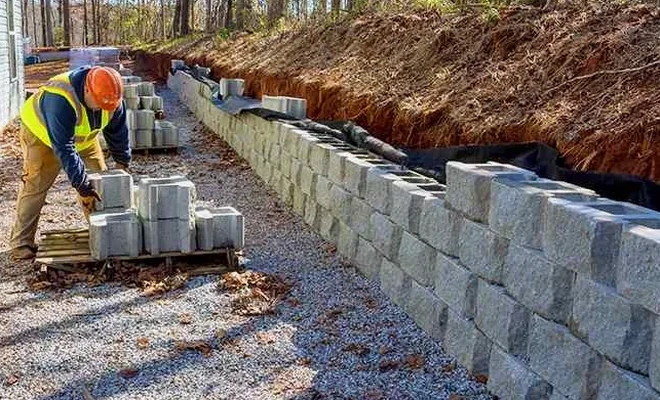
We specify a continuous drainage blanket of clean, free-draining aggregate at least 12 inches thick behind the stem, with a perforated collector pipe at the toe that daylights to a suitable outlet. Filter fabric separates the drain rock from the retained soil. In Sioux City's loess, omitting this detail almost guarantees hydrostatic buildup and wall distress within the first few freeze-thaw cycles.
How do you handle the loess soils when designing a retaining wall?
Loess requires careful handling because it loses significant strength when saturated. We use drained strength parameters from consolidated-undrained triaxial tests on undisturbed samples, assume zero cohesion for long-term design, and set the backfill zone entirely with imported granular material. The retained loess is benched and compacted to prevent sloughing during construction.