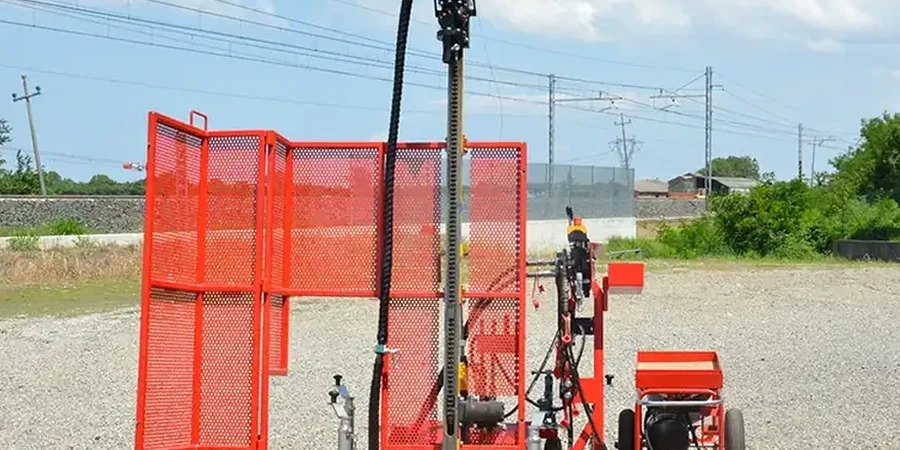
The split-spoon sampler drops 30 inches at a time, driven by a 140-pound hammer, and in Sioux City that rhythmic thud echoes across the Missouri River bluffs more often than most people realize. We run SPT rigs on the fine-grained loess that caps the hills and through the alluvial sands of the floodplain, where the N-value can shift from refusal to single digits in less than two feet of depth. The Standard Penetration Test remains the backbone of subsurface investigation here because it delivers both a disturbed sample and an in-situ resistance measurement in one pass, something no CPT cone can replicate when the silts are interbedded with gravel lenses. Our crews know the local geology well enough to anticipate those transitions, and we calibrate hammer energy regularly to keep the data compliant with ASTM D1586 and the IBC Chapter 18 requirements that govern most Woodbury County permits.
In Sioux City, the difference between a 12-blow and a 45-blow SPT at 15 feet can mean the difference between spread footings and deep piles.
Methodology and scope
Sioux City sits on a topographic staircase: the flat Missouri River bottomlands rise abruptly into steep loess-mantled hills, and that contrast forces foundation engineers to think in vertical sections. On the floodplain, where saturated sands dominate, we often pair the SPT program with a
liquefaction assessment to evaluate cyclic resistance ratios under the design earthquake, because the 2011 Missouri River flood reminded everyone that groundwater here is rarely deeper than 10 feet. Up on the bluffs, the loess can stand nearly vertical in cuts but collapses rapidly when wetted, so we use SPT blow counts to gauge collapse potential and to decide whether
stone columns or rigid inclusions are needed before placing footings. The test itself is deceptively simple: we record blows per 6-inch increment over 18 inches, discard the seating drive, and report the sum of the second and third increments as the N-value, all while logging moisture, color, and consistency from the split spoon recovery.
Local ground factors
Sioux City's late-19th-century stockyards and rail expansion pushed development onto deep alluvial fills along the Floyd River, and we still encounter buried organic silts, old timber piles, and undocumented fill in those industrial corridors today. The biggest geotechnical risk in these areas is differential settlement caused by highly variable SPT refusal depths: one boring may hit weathered chalk at 25 feet while the next, only 40 feet away, finds soft clay to 60 feet. When the SPT log shows N-values below 4 in saturated fine sands, the potential for flow liquefaction must be evaluated, and the IBC requires a site-specific response analysis if the mapped spectral acceleration exceeds 0.15g, which it does across most of Sioux City. We have seen projects where skipping deeper SPT investigation led to pile toe punching through a thin dense layer into underlying loose sand, a failure mode that terrain reconnaissance alone cannot predict.
Common questions
What depth of SPT boring is typically required for a single-family home in Sioux City?
For residential construction on the loess hills, we usually drill to 20 or 25 feet, provided refusal is not encountered earlier. On the Missouri River floodplain, where compressible alluvium can extend deeper, 30 to 40 feet is more common to capture any soft layers that would influence footing settlement.
How much does an SPT investigation cost for a standard commercial lot in Sioux City?
For a typical commercial lot requiring two borings to 30 feet with full logging and a summary report, the cost ranges from US$540 to US$780 per boring, depending on access conditions and whether mud rotary is needed below the water table.
Do you correct SPT N-values for overburden pressure and hammer energy?
Yes. We measure hammer energy ratio directly using strain gauges and accelerometers mounted on the rods, and we apply overburden correction factors following the Liao & Whitman method. Every log we deliver includes both raw N-values and corrected N60, along with the measured energy ratio for each test interval.
Can SPT data alone be used for liquefaction screening under the IBC?
SPT data is the most widely accepted basis for liquefaction triggering analysis using the simplified procedure by Seed & Idriss, updated by Youd et al. (2001). We need corrected N60 values, fines content from lab testing, and groundwater depth measured in the field. If the SPT refusal is shallow, we may supplement with CPT soundings to profile deeper strata.