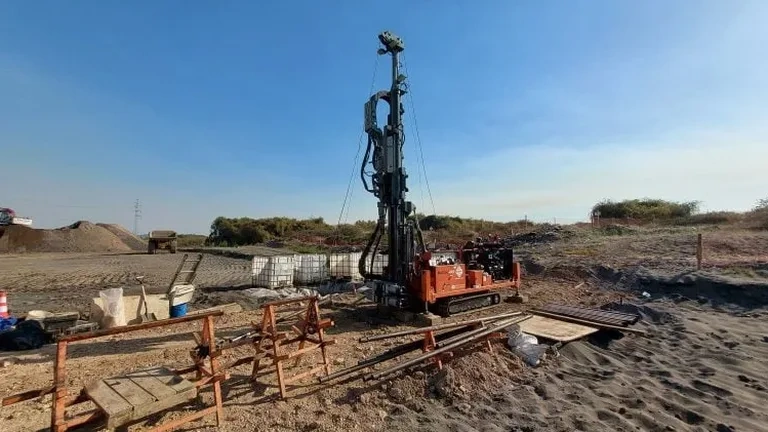
Sioux City sits on a dramatic geological boundary where thick loess-mantled bluffs drop into the soft alluvial clays and sands of the Missouri River floodplain. The USGS mapped the loess here as part of the Peoria Formation, reaching depths of 20 to 50 feet across the western uplands, while the bottomlands conceal buried channel deposits and discontinuous sand lenses that complicate shallow foundation design. An exploratory test pit provides the most direct way to observe these transitions: you can see the contact between weathered loess and underlying glacial till, check moisture conditions at depth, and collect undisturbed block samples from specific horizons. In a city where frost depth reaches 42 inches per IBC Table R301.2, and where the expansive potential of weathered loess can wreck a slab-on-grade in five years, visual inspection of the soil profile in an open excavation is worth more than a dozen split-spoon samples alone. Our team runs these test pits in residential lots near Morningside, commercial pads along Hamilton Boulevard, and industrial sites down by the river, coordinating with the CPT testing crew when the project needs continuous stratigraphic profiles to complement the pit observations.
An open test pit in Sioux City's loess terrain reveals what no borehole can: the real contact between fill, weathered loess, and competent bearing stratum.
Local ground factors
A five-story mixed-use building going up on a former industrial parcel along the Floyd River channel—that's a scenario we see more often now with downtown redevelopment. The geotech report from the preliminary borings showed stiff clay from 8 feet down, but the borings were spaced 80 feet apart. When we opened two exploratory test pits between the boring locations, we found a buried sanitary sewer trench backfilled with loose sand and construction rubble, cutting diagonally across the proposed footing line. Differential settlement under that corner would have cracked the slab and sheared the brick veneer within the first two years. The pit investigation caught it before the rebar went in. Sioux City's older neighborhoods, from the Heights to the West End, are full of these legacy disturbances—old cisterns, undocumented utility corridors, even buried foundation walls from demolished structures. A footing inspection at the base of a test pit gives the structural engineer a direct look at the bearing surface, something no geophysical method can replicate with the same certainty.
Common questions
How deep can you excavate a test pit in Sioux City's loess soils?
In the loess uplands, we typically reach 12 to 14 feet with benched slopes cut at a 1.5:1 ratio, which is the safe configuration for Type B soil under OSHA 29 CFR 1926 Subpart P. Going deeper requires shoring or a transition to drilled borings. The loess here stands vertically when dry but sloughs fast if it rains, so we schedule pits during dry weather windows and cover the excavation with plastic if there's any chance of precipitation.
What does an exploratory test pit cost for a residential project in Sioux City?
For a standard residential test pit program—typically two pits to 10 feet depth, with logging, photography, bulk sampling, and a summary letter—the cost runs between US$430 and US$950 depending on access, spoils disposal, and whether we need to mobilize a smaller rubber-tired backhoe for tight lots in neighborhoods like Morningside or the North Side.
Do I need a test pit if I already have soil borings done?
Borings give you a vertical profile at discrete points; a test pit gives you a continuous horizontal and vertical view across several feet of excavation, which is critical for spotting fill seams, old foundations, or utility trenches that a boring might miss entirely. In redeveloped areas of Sioux City—especially downtown and the former stockyards district—we recommend at least one test pit to verify boring interpretations before finalizing foundation plans.