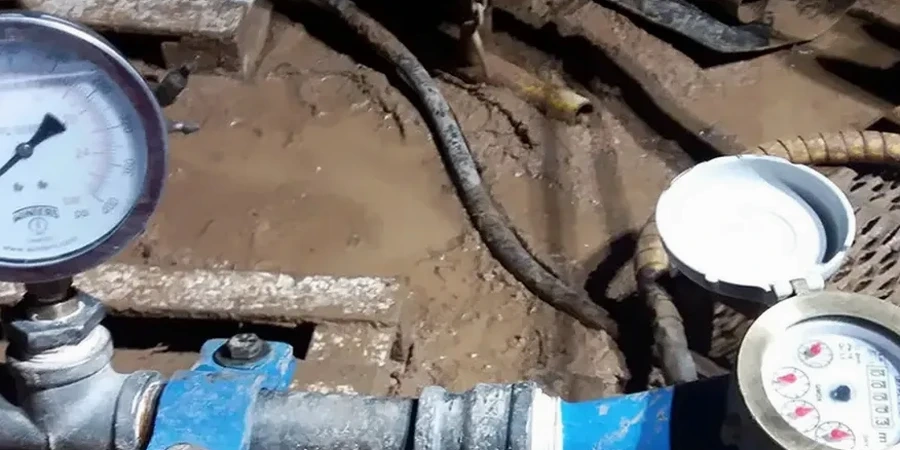
At 1,200 feet above sea level along the Missouri River, Sioux City sits on a layered profile of loess-mantled bluffs and alluvial floodplain deposits. Permeability here is anything but uniform. A routine infiltration test in the Floyd River valley can show conductivity three orders of magnitude higher than what you get in the compacted glacial till under the bluffs. That contrast matters when you are designing a retention basin near Bacon Creek or evaluating underdrain capacity for a commercial lot on Gordon Drive. We run in-situ permeability testing using Lefranc procedures in boreholes and Lugeon tests in bedrock, following ASTM D6391 and USBR guidelines. The data we deliver feeds directly into dewatering plans, cutoff wall specifications, and groundwater modeling without relying on recompacted lab samples that rarely represent field conditions.
A Lefranc test in undisturbed loess often shows vertical conductivity 10 times higher than horizontal — you miss that entirely with a lab falling-head test.
Local ground factors
We reviewed a project near the Big Sioux River confluence where the contractor skipped field permeability testing and used generic lab values from a borrow source. Three months after the stormwater vault went in, groundwater buoyancy lifted the empty structure two inches out of alignment. In Sioux City’s Missouri River corridor, the water table can rise fast after spring melt and heavy rain events, turning a moderately permeable silt into a fully saturated hydraulic connection. Ignoring in-situ in-situ permeability values during the design phase leads to undersized sump pumps, failed cutoff walls, and infiltration basins that overflow during the first wet season. We measure the actual hydraulic conductivity where the soil sits, under natural stress and saturation, so your drainage model reflects reality — not an optimistic table from a textbook.
Common questions
What is the typical cost of a Lefranc or Lugeon test in Sioux City?
Field permeability testing in Sioux City typically ranges from US$600 to US$1,140 per test interval. The final cost depends on borehole depth, number of test zones, access conditions along the loess bluffs or river bottomlands, and whether single or double packer setups are needed for the Lugeon procedure.
How many Lugeon pressure steps do you run per interval?
We run five pressure steps per isolated interval. The sequence goes low, medium, high, medium, low. This pattern reveals fracture dilation or clogging behavior — if the Lugeon value at the last low step is higher than the first, the rock mass is opening up under pressure, which directly affects the grouting strategy.
When do you recommend a Lefranc test over a lab permeameter?
We recommend a Lefranc test whenever the soil fabric matters — loess with root holes, varved clays, or sandy lenses in till. A lab permeameter test on a 2-inch sample cannot capture the macropores and layering that control field permeability. The Lefranc test measures the soil in place, under natural confining stress and with all its heterogeneities intact.