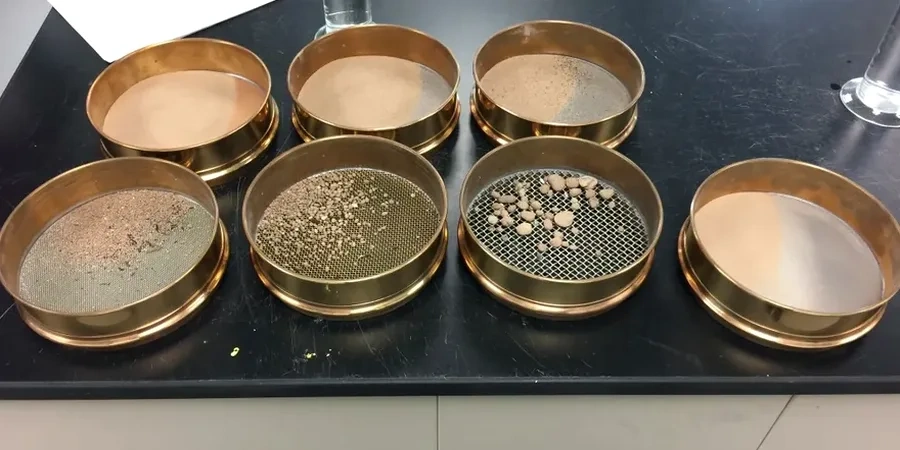
Along the Missouri River corridor in Sioux City, we routinely encounter soil profiles that shift from clean sands to fat clays within the same boring. That variability, driven by the river's historic meandering and overbank deposits, makes grain size analysis a non-negotiable first step for any foundation design here. A standard sieve stack handles the coarse fraction down to the No. 200 sieve, but it's the hydrometer test that reveals the real story in the silt and clay range. We see this pattern constantly on projects near the Floyd River confluence, where layered alluvium creates confusing field descriptions. Without a full combined curve, you're guessing at drainage behavior, frost susceptibility, and whether that 'silty sand' the driller logged is actually a liquefiable fine sand. In Sioux City's older industrial districts along the riverfront, we often pair particle size data with test pits to visually ground-truth stratigraphy before committing to a bearing stratum.
Sioux City's Missouri River floodplain soils can shift from well-graded sand to elastic silt in less than five vertical feet—a combined sieve and hydrometer curve is the only way to catch that transition.
Local ground factors
Sioux City sits at roughly 1,200 feet elevation on the Missouri River, and the 2011 flood event reminded everyone here that water and fine-grained soils do not mix well. Much of the commercial development south of downtown occupies former floodplain with up to 30 feet of alluvium over glacial till or shale bedrock. When grain size analysis is skipped or done with sieve-only methods on these soils, the biggest risk we see is misclassifying gap-graded silts as well-drained sands. That error cascades into underestimated liquefaction potential—the USGS seismic hazard maps for Woodbury County are not zero, and the NCh-equivalent IBC/ASCE 7 requires Site Class determination that depends directly on the fines content and gradation parameters. A project that assumes Site Class D based on SPT blow counts alone, without verifying the grain size distribution, can end up with unconservative seismic design coefficients. We have also seen retaining wall drainage systems clog because the filter aggregate was designed from a sieve-only curve that missed the hydrometer fraction. In Sioux City's freeze-thaw climate, the percent finer than 0.02 mm directly controls frost heave susceptibility per USACE criteria.
Relevant standards
ASTM D2487-17e1: Standard Practice for Classification of Soils for Engineering Purposes (Unified Soil Classification System), ASTM D422-63(2007)e2: Standard Test Method for Particle-Size Analysis of Soils (combined sieve and hydrometer), ASTM D7928-21e1: Standard Test Method for Particle-Size Distribution (Gradation) of Fine-Grained Soils Using the Sedimentation (Hydrometer) Analysis, ASCE 7-22: Minimum Design Loads and Associated Criteria for Buildings and Other Structures (Site Class determination, Chapter 20), IBC 2021: International Building Code (Section 1803 geotechnical investigation requirements)
Common questions
How much does a full grain size analysis (sieve plus hydrometer) cost in Sioux City?
A combined sieve and hydrometer test in our Sioux City lab typically runs between US$100 and US$180 per sample, depending on whether we are running it as a standalone test or as part of a larger geotechnical testing program. The price covers oven drying, mechanical sieve stack with wash, hydrometer sedimentation with readings at standard time intervals, and the final report with gradation curve and USCS classification. Turnaround is generally 3 to 5 business days.
When is a hydrometer test required versus just a sieve analysis?
Per ASTM D2487 practice, if visual inspection or the wash over the No. 200 sieve shows more than 12 percent fines by dry weight, a hydrometer test is needed for proper classification. In Sioux City's Missouri River alluvium, we almost always recommend hydrometer because fines content can jump from 8 to 60 percent across a single boring and field estimates are notoriously unreliable with silts.
What sample size do you need for a grain size test?
The required mass depends on the maximum particle size per ASTM D6913. For soils with maximum particle size up to 3/8 inch (9.5 mm), we need approximately 500 grams of oven-dried material. If gravel up to 3 inches is present, the required mass increases to around 30 kilograms. For hydrometer testing specifically, we need about 50 grams of the minus No. 10 fraction from the original sample. We can guide your field crew on proper sampling procedures before they mobilize.
How do grain size results influence foundation design in Sioux City?
The gradation curve directly feeds into multiple design decisions. The percent fines and D50 control liquefaction susceptibility assessment per Seed and Idriss-based methods referenced in ASCE 7. The D10, D30, and D60 provide filter design criteria for drainage layers behind retaining walls. And the USCS classification from the combined curve dictates whether we are dealing with a free-draining granular soil suitable for shallow footings or a moisture-sensitive fine-grained soil that may require deep foundations or ground improvement.